


Official Home to Erle Montaigue's
Fa-jing Chuan Combat & Healing Schools
Taiji | Bagua | Qigong
The World Taiji Boxing Association
The definitive resource for Taiji and Bagua as taught by Erle Montaigue and his successor, Eli Montaigue


What does this school offer?
Originally built by Erle Montaigue, Taiji World has one of the largest online training platforms of it's kind, covering all aspects of the internal martial arts Taiji and and Bagua, the Combat and the Qigong.
Free books and videos, live online classes with Eli and his world wide workshop dates, and of course, Erle's life's work on his 390 MTG videos, covering every aspect of Fa-jing Chuan, The Erle Montaigue System of Combat & Healing.
Fa-jing Chuan means Explosive Energy Chinese Boxing. It was the name chosen by Erle Montaigue to encompass the different styles and training he gathered from around the world. The bulk is made up of the traditional Chinese martial arts, Taiji or "Taijiquan" & Bagua or "Baguazhang".
There is often a lot of esoterically mumbo jumbo associated with Taiji and Bagua, but if you can filter through and find someone teaching how it was originally intended, you'll find a beautiful balance of practical fighting methods and amazing health forms/qigong.

An Overview
An Overview

Combat & Healing
It's an odd concept for most, but fighting and healing go hand in hand.
Often people think that only the forms and qigongs are for healing, but in so many ways the combat training heals you. For example: if your emotional baggage is from some kind of violent assault, that trauma you hold inside might still be there because you're scared. By putting yourself into these rough situations and learning how to break free of them, toughening yourself up, you can let go of this trauma.
We have seen this happen many times. Aside from that, even if you don't have any trauma, this area of your training will make you so much calmer within yourself. The calmest most chilled out person you ever see, is one who knows how to fight, but also has nothing to prove. If you're afraid of being attacked, you'll never find peace, you're also far more likely to seriously injure or kill someone if you are untrained, learning how to fight also teaches you about control.
You want to get the yin calmness, you need to train the Yang! It's all about balance.
The internal martial arts are about creating balance of the internal and external systems of the body, so the practice incorporates these into your training. Just because it's an "Internal" Martial Art, doesn't mean we focus purely on qigong and negate the physical and external areas of the body, so the practice will work every area of your body, stretching and strengthening, cardiovascular, bone health, qigong and the mind everything is included. Sometime we focus more on either the physical or the internal depending on what the student needs, but ultimately the two should become one.


Most of what we train is applicable to both these styles. However, forms and some training methods are style specific.
Both styles are individual but also complimentary to each other, which one you choose is a personal choice, but we have a page that explains the differences between the two in order help you decide what is right for you. More....
The fighting area of the internal martial arts are trained for self defence rather than competition. The main difference is, you learn to make use of all the illegal strikes, such as attacking the eyes, groin, neck and back of the head, as well as stomping on a grounded opponent, things that will give you a fighting chance against a bigger opponent. We never take a fight to the ground, it's not a good place to be in a street fight. If we do end up on the ground however, we have grappling skills to get us back to our feet. Gloves are for training without hurting your partner, but in a real fight you won't have these, therefore we do most of our training without gloves, this means that even though some of the strikes might seem similar to western boxing, the philosophy behind them and how we move is very different.
Full contact fighting will make you the best fighter you can be, but at what cost? The answer is your health. Any full pressure fighting, striking or grappling based, will wreck your body. We prefer to train at a medium pressure, negating any health risk. This means you might not become the ultimate fighting weapon, but you will be able to protect yourself and your family from 90% of situations, and maintain a healthy mind and body into your old age. We do use full pressure for some things, like when doing a training method where you know the contact will only be to certain areas of the body, this way the student can still get the feel of how to deal with full force in a safe way.
Sparring is done with and without protective equipment. We make sure our system can stand up to other styles, not by entering into competitions, but by meeting up and training with like minded people from Boxing, Muay Thai, BJJ etc. If you train for competition, full force to the knock out, you'll have the upper hand on dealing with full force, but if you train for self defence you'll have the upper hand of training your reflexes to go for the most vulnerable points and learning defensive methods that work when there is a large size difference. Who would win in a fight is anyones guess, it's never been tested, but always remember, the chances of a normal kind person getting attacked by a pro level MMA fighter is next to nothing.
If you train MMA without the full force, now you've lost your advantage and would be better off training for self defence. You can't train full force without rules, well you can, but only once. You just need to make sure the system you're following has been tried and tested. Ultimately what you train in is what you enjoy doing, or what you have access to, any good system will teach you to fight, you just need to weigh up the pros and cons of a style to see if it fits you.
The internal arts are built on Fa-jing and Dim Mak, but not in the same way you see all over the internet where people make it out to be almost supernatural.
Fa-jing simply means Explosive Energy, this is how we strike with great power over a short distance, the whole body shakes like a sneeze and we concentrate that force down into the striking weapon. You don't see this is western boxing due to the gloves.
To do damage with a boxing glove, you need to compress the padding in the glove, this means you need to punch in much deeper. Fa-Jing is an explosive snap which only works bare handed, giving you the ability to strike from a shorter distance.
Dim-Mak, simply means to hit the most vulnerable points on the body, no you cannot touch someone's arm and have them fall to the ground, but you can aim at the weakest area of a big guy and at least have a far greater chance of getting away compared with just punching him in the face. You will see this in western boxing, but only on a very basic level due to the rules and the gloves. The rules mean that there are many areas you are not allow to strike, the neck for example. The gloves cushion and spread out the power, meaning a liver shot will still work really well, but a strike to Triple Heater 17 just behind the jaw will not. Point strikes to the arms can work very well on someone not use to it, this can be a great way of subduing an attacker in a not serious situation, but just keep in mind that if they are trained, or are off their face on drugs, these points will not work like they do in the movies.
.jpg)

.jpg)

When you learn from the Montaigue's or one of their many representatives around the World

Your instructor will work with you to identify your specific training goals, whether you are seeking self-defense skills, injury rehabilitation, mental clarity, or an overall boost to your health and well-being. We offer a diverse range of traditional forms and partner-based drills, covering everything from combat applications to Qigong healing, ensuring you get exactly what you need from your practice.
You can choose to focus solely on solo forms and Qigong, or integrate partner training like Push Hands. For those wanting a more martial orientation, we offer San Sau, pad work, and free-fighting.
If you aspire to become a certified instructor under the WTBA, we will provide the comprehensive guidance necessary to help you become a skilled teacher.
You will learn to master the principles behind our forms and training methods. This approach teaches you how to move and respond effectively in any situation and from any angle, rather than simply memorizing sequences. While learning the forms is essential, we prioritize the underlying principles of movement and combat mechanics.
While our global curriculum remains consistent, every instructor brings their own unique style and perspective to the training. This allows each teacher to find their own rhythm, ensuring that the information is explained in a way that is clear, engaging, and personal to their students.


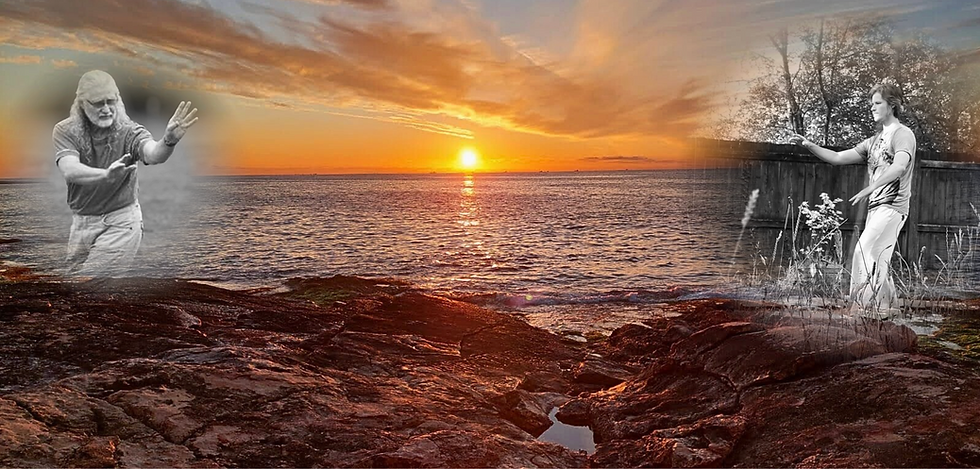
Erle’s family: his wife Sandra and their five children: Erland, Kristian, Ben, Eli, and Katalina, all shared in his martial arts journey, creating a legacy that spans generations. As seen in the photographs throughout this page, the internal arts were a way of life for the entire Montaigue family.
In 2009, Erle officially appointed his youngest son, Eli, as his successor and the head of the WTBA. Eli transitioned into the role of a full-time professional instructor, traveling worldwide with his father to every workshop and gradually assuming leadership of the Erle Montaigue System of Fa-jing Chuan.
Erle continued to teach workshops and produce instructional videos until his passing in 2011. Today, Eli continues that mission, ensuring the lineage of combat and healing remains accessible to students around the globe.

Eli now runs the WTBA with his wife Fran, who became an instructor in 2026.
Their two children Clara and Gaby have also begun training.
Eli's brother Ben does not teach, but still trains with Eli.


